As we enter February, AI in 2026 has started off with a rare mix of momentum and maturity. The momentum is obvious: the tools keep getting better, the use cases keep expanding, and more people are discovering what AI can do when it’s embedded into everyday work.
But maturity is the more important story. We’re moving past the era where excitement came from what you could demo and into the era where value comes from what you can run reliably, day after day, at scale, with measurable results. The coming year will reward teams that treat AI as more than a tool. The strongest outcomes will come from pairing capable models with clear workflows, good data, and thoughtful design so AI becomes a repeatable contributor to speed, quality, and customer experience.
At the same time, 2026 will be shaped by realities that don’t show up in demos: finite compute, real operating costs, security and compliance expectations, and the messy details of integrating AI into systems that were never built for it. Those constraints won’t slow AI down so much as they’ll decide who can scale it—and who stays stuck in experiments.
In this article, we’ll look at what that practical impact means in 2026: where enterprise adoption is accelerating, why costs and efficiency are becoming decisive, how consolidation is reshaping the AI platform landscape, and why trust, including security, auditability, and regulation, is becoming a baseline requirement. We’ll also explore what to expect as automation expands beyond software and robotics becomes more visible in real workplaces, alongside the infrastructure constraints that will quietly shape the pace of adoption.
Robotics Gets Real: Automation Steps Off the Screen
In 2026, robotics starts to look less like a science project and more like a practical extension of business automation. The near-term winners aren’t robots that “do everything,” but robots that reliably do one or two jobs in environments that are predictable enough to measure performance and manage risk. That’s why factories, distribution centers, and warehouses are the front edge: structured spaces, repeatable tasks, and clear ROI.
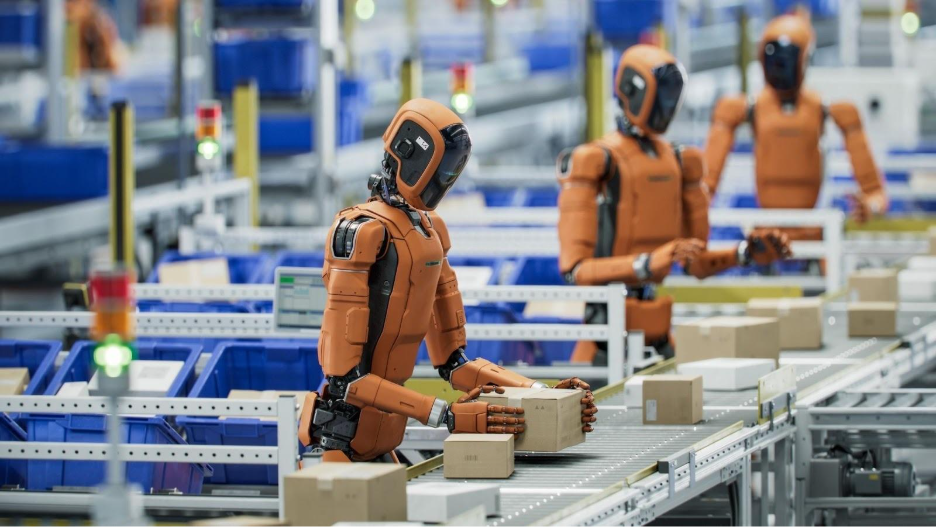
The most important shift is that AI is improving how robots perceive and adapt, not just how they move. In warehouse settings, computer vision is increasingly replacing scanning-heavy manual processes. Gartner’s outlook that half of companies with warehouse operations will leverage AI-enabled vision systems by 2027 points to what 2026 will feel like: more sites adding vision-driven automation for inventory accuracy, safety monitoring, and process compliance rather than betting everything on humanoids. (AI-enabled vision systems in warehouses)
What to expect most in 2026:
- “Factories first” humanoids: mostly pilots or tightly controlled production cells, not free-roaming general labor (humanoids stall at pilot scale)
- More non-humanoid automation that wins on throughput-per-dollar (wheeled, purpose-built “polyfunctional” robots)
- Faster iteration inside companies already building at scale, like Tesla shifting Optimus training to its Austin factory in early 2026 and talking about initial production ramping slowly (Optimus training at Austin)
At home, 2026 is still an “early curve” year. You’ll see better demonstrations and more believable prototypes, but households are messy, safety-critical, and cost-sensitive—so broad consumer adoption lags behind business use. The clearer 2026 trend is: robots become normal at work first, while “helpful home humanoids” remain aspirational, expensive, and limited in what they can reliably do.
Enterprise AI Adoption Grows: ROI Comes From
Repeatable Workflows
AI is showing up across more departments in 2026, but the payoff isn’t evenly distributed. Broad adoption is real, yet the biggest financial returns tend to come from a narrower set of workflows that are high-volume, measurable, and already somewhat standardized. Survey-driven research on enterprise AI usage suggests many companies are now past the “experimenting” phase, but far fewer have truly scaled it end-to-end across the enterprise (the State of AI survey findings).
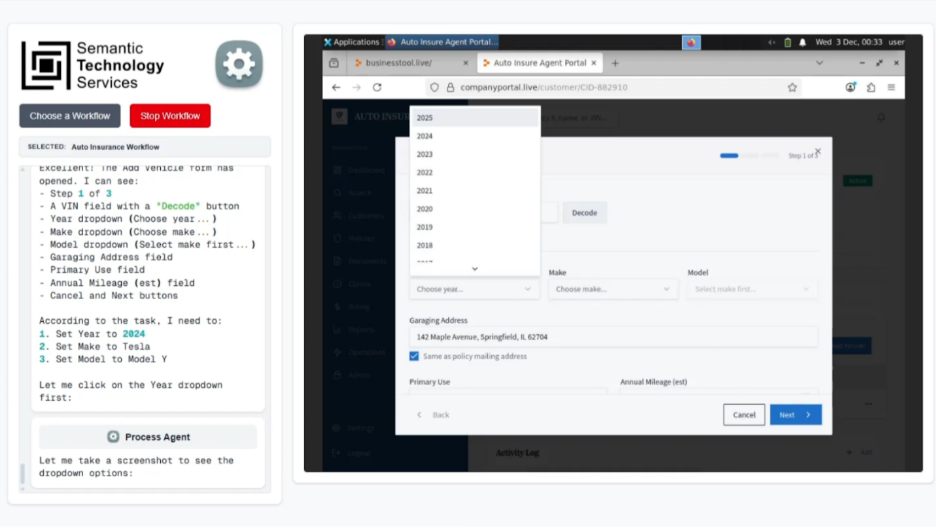
That gap between “we tried it” and “we run it” is exactly where ROI gets decided. The organizations seeing outsized returns aren’t necessarily deploying AI everywhere; they’re focusing on repeatable processes where outcomes can be tracked and improved over time (cycle time, cost per case, resolution rate, error rate). You can see this mindset in how some large enterprises talk about AI value creation—framing it as enterprise value tied to specific initiatives rather than vague innovation, as described in coverage of RBC’s expectations for AI-driven value (RBC enterprise value from AI).
Where ROI most often clusters first:
- Customer service (faster resolution, higher containment, better agent assist)
- HR and internal ops (employee onboarding, policy Q&A, ticket triage)
- Supply chain / procurement (forecasting support, exception handling, document-heavy steps)
- Software delivery (developer copilots, testing, code review acceleration)
What ties these together is not “AI magic,” but workflow fit: clear inputs, repeatable decisions, and a straightforward way to measure improvement. Guidance on making AI “enterprise-ready” frequently emphasizes this transition from automation experiments to operational autonomy supported by governance, controls, and clear accountability.
The practical takeaway: if you want ROI in 2026, start by choosing one or two workflows where impact is easy to measure, exceptions are manageable, and stakeholders agree on what “better” means—then scale from there.
AI Hits Real-World Constraints: Why Infrastructure Sets the Pace
In 2026, AI’s momentum will be shaped as much by the physical world as by clever algorithms. The big shift is that “more AI” increasingly means “more infrastructure”: more electricity to feed power-hungry clusters, more cooling to manage heat density, and more specialized manufacturing capacity to assemble cutting-edge chips into usable high-performance modules. This is why progress won’t look smooth or evenly distributed. Some organizations will move fast because they can secure capacity; others will hit friction because the underlying resources simply aren’t available where and when they need them.
The power story is a good example. According to analysis summarized by the U.S. Department of Energy in this piece on rising data-center electricity demand, U.S. data centers already account for a meaningful share of national electricity use and are projected to grow quickly in the next few years—growth that is being accelerated by AI workloads. The implication is straightforward: grid capacity, permitting timelines, and construction schedules become hidden “speed limits” on how quickly AI can be deployed at scale.

Then there’s the supply chain. Even with strong demand and big budgets, organizations can still be constrained by the specialized steps required to turn advanced chips into the finished modules used in modern AI systems. A helpful way to think about this is: the chip itself is only part of the product. Before it can power an AI cluster, it has to be “packaged” together with memory and high-speed connections in a form that can be installed in servers and run reliably at scale.
That’s why advanced packaging—often discussed in the context of CoWoS (Chip-on-Wafer-on-Substrate)—matters. CoWoS is one of the key processes used to pair high-performance compute with the memory bandwidth AI workloads rely on. When that packaging capacity is tight, it becomes a bottleneck even if there’s plenty of demand and plenty of money. Late-2025 reporting suggested this constraint was very real: TrendForce noted that TSMC’s CoWoS-L/S capacity is reportedly fully booked, and that more overflow work is being pushed to OSAT partners as the ecosystem tries to increase throughput. Investing coverage echoed the same idea from another perspective, arguing that AI momentum isn’t the limiting factor—packaging throughput can be, because it influences how fast shippable accelerators actually reach the market (packaging as the bottleneck).
What this means in plain language:
- You can’t scale AI just by “buying more GPUs” if the upstream packaging pipeline can’t deliver finished modules fast enough
- Availability becomes uneven: some buyers get allocation, others face delays
- It increases the premium on efficiency and planning; getting more value from the compute you already have
In short, the supply chain constraint is more than just about manufacturing chips. It’s about the less-visible steps required to assemble them into production-ready AI hardware.
The Economics Pivot: Cost-per-Task, Latency & the Race to Efficiency
If 2024–2025 was dominated by excitement about building and training bigger models, 2026 is when the economics get decided by something less glamorous: running them. For most organizations, the main bill isn’t the one-time cost to create a model. It’s the ongoing cost of serving AI to employees and customers day after day. That shift is why “inference” (the compute used to generate responses in real time) becomes the primary cost center, and why efficiency starts to matter as much as capability.
A big clue is how AI is increasingly commercialized. Reporting highlighted by Data Center Dynamics describes how major providers are already turning inference into a large, recurring revenue engine, underscoring that the “serve” side of AI is where value (and cost) concentrates (see the discussion of Microsoft’s inference-driven revenue trajectory in this coverage).
The takeaway isn’t just that inference is big; it’s that inference is becoming a durable line item that businesses will optimize like any other operating expense.

That optimization shows up in new decision criteria. Instead of asking only “Which model is best?”, teams start asking “Which approach is cheapest per completed task?” and “What does it cost us to run this at 10x usage?” The energy dimension becomes part of that equation. Analyses like this write-up on AI inference costs and energy pressures point to a future where the marginal cost of large-scale AI usage is tied not only to GPU pricing, but also to power availability and energy efficiency. In other words: even if per-query costs fall, usage grows so quickly that total spend can still rise—unless efficiency improves.
How this changes AI strategy in 2026:
- “Pilot budgets” turn into operating budgets (recurring inference spend)
- Efficiency becomes a feature: latency, throughput, and utilization drive ROI
- Energy and capacity constraints start to influence architecture choices (what runs where, and how often)
2026’s winners will be the ones who treat AI like a product with unit economics. The best teams will measure cost per workflow outcome (not cost per prompt), design experiences that minimize unnecessary calls, and choose systems that deliver reliable performance without turning inference into an uncontrollable expense.
Fewer Big “AI Engines”: Consolidation and the Platform Era
By 2026, most organizations won’t be “choosing among dozens of foundation models” the way they might pick SaaS tools. The economics and logistics of building frontier-grade AI—massive compute needs, specialized hardware supply chains, and the ongoing cost of serving models at scale—push the market toward a smaller number of default “AI engines.” In practice, that means fewer companies can afford to train and operate cutting-edge models end-to-end, and more companies will consume those capabilities through platforms and partnerships.
One driver is simple scarcity. Analyses of AI capacity and advanced packaging constraints suggest that access to high-end compute and the ability to scale it efficiently isn’t evenly distributed, and that reality tends to concentrate power among a handful of players who can secure supply and build out infrastructure. When the inputs are scarce and expensive, the number of viable “builders” shrinks.

At the same time, enterprises are standardizing. Survey-based reporting on how companies are adopting AI shows that organizations are moving from experimentation toward more deliberate, governed deployments—an environment where stability, security posture, and integration matter as much as raw model performance. That naturally favors a shorter list of approved platforms.
What consolidation looks like on the ground:
- Deeper partnerships between regulated industries and model providers to address security, privacy, and customization needs
- Fewer strategic vendors as companies standardize on 1–3 core platforms to simplify governance and cost control
- More “distribution-first” deals where cloud, data, and model capabilities are bundled into one commercial relationship
A good example of partnerships hardening is the move by major incumbents to pair with specialized AI firms to build secure, domain-relevant capabilities—like the collaboration described in this announcement of an RBC and Cohere partnership for secure generative AI in financial services. The broader implication for 2026 is that “model choice” becomes less about shopping and more about committing: the AI provider you pick increasingly shapes your costs, controls, roadmap, and competitive pace.
Trust Becomes Mandatory: Guardrails, Governance & Real Oversight
In 2026, the organizations that scale AI successfully will treat it like production software—because the risks now look like production risks. As AI moves into workflows that touch sensitive data, customer outcomes, and regulated processes, “trust” stops being a principle and becomes an operating requirement. That means controlled deployment: clear rules on what data can be used, what systems AI can access, and how decisions are monitored, logged, and reviewed. The goal isn’t to slow adoption—it’s to make expansion possible without creating a security and compliance debt that eventually forces a reset.

This is also why sovereignty is no longer a niche topic. Where AI runs, and which legal frameworks govern the data and infrastructure, has become part of the trust conversation, especially for regulated or data-sensitive sectors.
The risk isn’t theoretical: when workloads live inside an ecosystem governed by another jurisdiction’s rules, you inherit exposure and uncertainty. That’s why the idea of “sovereign cloud” is increasingly discussed in practical terms—what it really means, what it doesn’t, and what trade-offs it creates (see this explainer on what sovereign cloud really means). And it’s why we’re seeing infrastructure framed as a strategic asset in Canada, through moves like Bell’s AI data centre plans and TELUS’ sovereign AI factory in Rimouski.
The practical takeaway is that 2026 rewards disciplined deployment. The teams that bake governance, auditability, and jurisdiction into their AI architecture will unlock broader rollout with confidence, while others stall under security reviews, compliance questions, and operational risk.
Make 2026 Your AI Adoption Year
As AI heads into its “real world” phase, the companies that win won’t be the ones with the most experiments. They’ll be the ones that turn automation into a repeatable operating advantage. The pattern across everything we’ve covered is consistent: constraints are real (compute, cost, governance, integration), but they don’t block progress. They reward focus.
When you pick the right workflows, instrument them with the right metrics, AI stops being a novelty and starts becoming throughput—faster cycle times, fewer handoffs, better service, and more resilient operations.
Semantic Technology Services (STS) helps organizations make that shift. We design and engineer enterprise AI automation that can handle complex decision-making, elaborate data flows, and operational logic at scale—so you can modernize processes without turning your business into a science experiment.
Whether it’s migrating legacy healthcare records without API access, saving hours each week in real estate reporting, or reducing daily scheduling overhead in clinics, the common thread is measurable improvement through automation.
If you’re ready to move from pilots to production—and from isolated tools to end-to-end automation—STS can help you identify the gaps, build the automation, and deliver outcomes you can measure. The next phase of AI belongs to the companies that execute.
Book a Demo Today!